
Nieman Lab

For the past 17 years, the Nieman Journalism Lab has served as an essential resource for a worldwide audience of journalists, academics, and analysts looking for original reporting, research, and commentary on the rapidly changing news industry in an increasingly tumultuous political environment.
The Lab continues to provide incisive reporting about the future of news, innovation, and best practices in the digital space. Itis paying special attention to the intersection of journalism and generative AI and the challenges and opportunities for local news in the United States.
Nieman Lab has a full-time staff of seven: Laura Hazard Owen, editor; Sarah Scire, deputy editor; Joshua Benton, senior writer; Sophie Culpepper, local news beat reporter; Andrew Deck, AI beat reporter; Neel Dhanesha and Hanaa’ Tameez, general assignment writers.
Nieman Lab posts on every major social media platform but, like many other publications, is putting renewed effort into attracting readers to its own products: its daily and weekly newsletters, with more than 70,000 subscribers combined, and its website. Lab stories are regularly cited in leading news outlets, including The Atlantic, Axios, The Boston Globe, CBS, CNN, the Financial Times, The Globe and Mail, the Los Angeles Times, MSNBC, New York magazine, Platformer, Politico, and The Verge.
In 2025, Lab journalists attended or spoke at events including the International Symposium on Journalism, the JournalismAI Festival, three AI workshops and events at the University of North Carolina, the IMEDD Incubator for Media Education and Development, the LION Independent News Sustainability Summit, INN Days, the Nordic AI in Media Summit, the Poynter/AP Ethics Summit, SRCCON, and the Society of Environmental Journalists’ annual conference.
Here’s a sampling of the top stories Nieman Lab published this year:
- For the first time, social media overtakes TV as Americans’ top news source
- Inside a network of AI-generated newsletters targeting “small town America”
- How did newspapers in places like Harrisburg, Birmingham, and Syracuse become some of America’s most-read online?
- National Trust for Local News sells 21 newspapers to a company with a history of gutting local outlets
- From reckoning to retreat: Journalism’s diversity efforts are in decline
- The Wayback Machine’s snapshots of news homepages plummet after a “breakdown” in archiving projects
- What went wrong at the Houston Landing?
- On “secret” radio stations nationwide, a decades-old news service has survived the move to digital
- How to leak to a journalist
- Law360 mandates reporters use AI “bias” detection on all stories
- Trump wants news outlets to get on board with “Gulf of America” — or else. Will they?
- ProPublica wanted to find more sources in the federal government. So it brought a truck
- A “win-win” partnership brings a surge of reporting firepower to hyperlocal news outlets around Boston
- Beyond pageviews: Small news nonprofits develop their own metrics to measure impact
The year ended, as it has each year since 2011, with a collection of predictions for journalism, a go-to resource for industry watchers written by a diverse group of smart digital thinkers and doers.
Nieman Reports

In 2025, Nieman Reports closely examined the accelerating disruption of the news industry and its impact on journalism. As social media platforms retreat from their commitments to digital security, verification, and fact-checking, misinformation and disinformation are proliferating. At the same time, creators and influencers on video-first platforms are increasingly the top source of news for audiences around the globe — often eclipsing traditional news outlets in popularity, impact, and authority.
Established sources of trustworthy information are also under greater political attack. In the U.S., the Trump administration is defunding and undermining public media. On college campuses, next-generation journalists are being tested by mounting pressures on their editorial independence, free expression, and even their physical safety.
Through its print issues and digital coverage, Nieman Reports explored what this shifting landscape means for journalists striving to earn trust, report facts, and engage audiences. The publication’s contributors explored how traditional news organizations can learn from the creator economy without compromising journalistic ethics, and why rigorous verification remains essential at a time when authenticated evidence is sometimes dismissed as biased coverage. Under the leadership of new editor Samantha Henry, Nieman Reports investigated the stakes of this moment for journalism through original reporting, analysis, and expert perspectives.
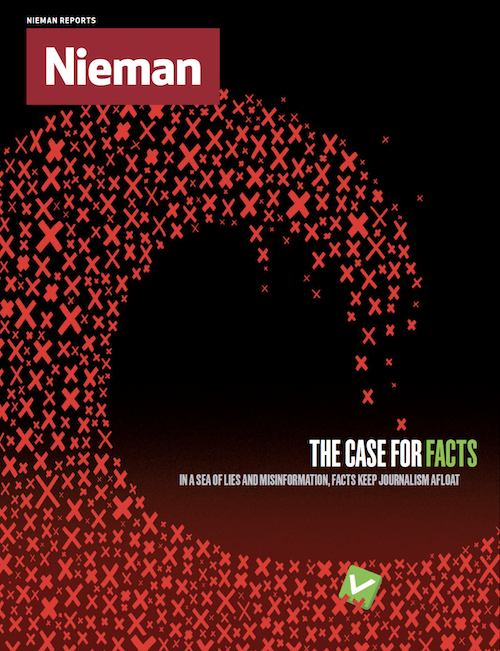
The Winter 2025 cover story, “The Case for Facts,” -upheld the primacy of verified fact as the bedrock of journalism but detailed how major platforms have scaled back or severed partnerships with the organizations that help keep online information reliable. Angie Drobnic Holan, director of the International Fact-Checking Network at the Poynter Institute and a 2023 Nieman Fellow, reported on Meta’s withdrawal from key fact-checking initiatives and how accusations of bias have become a political weapon, even as verification remains one of journalism’s core responsibilities.
Nieman Reports also looked beyond the U.S. to examine the global consequences of disinformation. James Okong’o, a 2025 Nieman Fellow who most recently worked as a digital investigation journalist for Agence France-Presse in Kenya, reported on how fact-checkers across sub-Saharan Africa work to debunk politically charged falsehoods arising from ethnic conflict, corruption, and coordinated propaganda campaigns.
Jon Marcus, senior higher-education reporter at The Hechinger Report, investigated how most local outlets in Maine have transitioned to nonprofit ownership. Independent journalist Bopha Phorn, a 2023 Nieman Fellow, reported on the arrest of veteran reporter Mech Dara, a case that illustrates the rapidly shrinking space for independent journalism in Cambodia. In another international feature, reporter Stefania D’Ignoti examined the lingering trauma endured by Italian journalists who covered the COVID-19 outbreak in northern Italy, the early epicenter of the virus in Europe.
Joel Simon, founding director of the Journalism Protection Initiative at the Craig Newmark Graduate School of Journalism, reported on how safety training for journalists has evolved far beyond conflict zones, becoming essential for reporters facing rising legal threats, online harassment, and the risks of covering politics and protests in the United States. Writer Gabe Bullard, a 2015 Nieman Fellow, examined the history and allure of the reporter’s notebook — the treasured tool of the trade that remains popular even as journalism becomes increasingly digital.
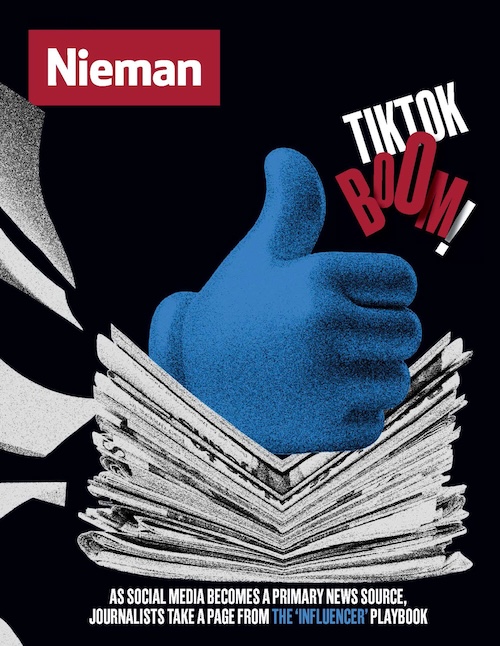
Nieman Reports’ Spring/Summer 2025 cover story focused on the rise of social media influencers, who are emerging as a dominant source of news for many Americans. Ryan Y. Kellett and Ben Reininga, both 2025 Nieman Fellows, studied how content creators on platforms such as TikTok are redefining how audiences consume news by making reporting feel trustworthy and relatable.
Dina Kraft, the Israel correspondent for The Christian Science Monitor and a 2012 Nieman Fellow, chronicled what critics call Israeli Prime Minister Benjamin Netanyahu’s “master plan to destroy the free media in Israel,” documenting the systematic efforts by the government to undermine independent media. Danny Fenster, a staff writer at Robert Wright’s NonZero Newsletter and 2023 Nieman Fellow, examined the ripple effects of American aid cuts to international journalism, detailing how the shuttering of the U.S. Agency for International Development (USAID) sent shock waves through independent media ecosystems worldwide.
Journalist Garry Pierre-Pierre examined how community-based outlets such as The Haitian Times, Epicenter NYC, and India Currents are delivering crucial information, resources, and connection to immigrant populations at a time of growing misinformation and anti-immigrant sentiment. The story details the financial and political challenges these outlets face, even as their importance becomes more vital.
In addition to the print magazine, Nieman Reports regularly publishes online-only opinion pieces, articles, and essays. Some of the top stories from 2025 include:
- I Was a Fixer. Here’s Why Journalism Needs to Rethink the Role
- With Cuts to Federal Funding, How Will Public Media in the U.S. Survive?
- Coping with Media Layoffs
- With International Students at Risk, Campus Newspapers Loosen Editorial Policies
- We Asked to See Your Reporter’s Notebooks. Here’s What You Shared
- After the Shooting Stops: Vets Talk About the Ripple Effects of Combat
- Lessons from Building an Online Toolkit to Aid Open-Source Investigations
- What I Learned From Reading 1,334 Grant Applications
- Chronicling the Hutterites Over Time
- Going Beyond War’s Cliches
Nieman Reports saw steady growth across its social channels in 2025 under the direction of the Nieman Foundation’s digital and audience engagement editor, Adriana Lacy. Following shifting platform trends, Nieman Reports joined Bluesky last winter to further engage online audiences. Assistant editor Megan Cattel and Nieman staff member Peter Canova also produced and edited a new series of vertical videos for Instagram, designed to introduce stories to new readers.
Several 2024 Nieman Reports articles were selected as finalists for the 2025 Mirror Awards, presented by Syracuse University’s Newhouse School of Public Communications, including Unparalleled and Unprecedented,” about the dangers of reporting in Gaza and the staggering death toll of journalists there, and package of three stories (“Unerased,”“We Had No Place to Save the Stories,” and “Saving the First Draft of History,”) about preserving journalism online.
The staff that produced Nieman Reports in 2025 included editor Samantha Henry; assistant editor Megan Cattel; contributing editors Laura Hazard Owen, Ellen Tuttle, and Mark Armstrong; publishers Ann Marie Lipinski (former curator of the Nieman Foundation) and Interim Curator Henry Chu; and Dan Zedek, a Boston-based independent designer.

In January we were excited to welcome a new editor for Nieman Storyboard: Mark Armstrong, founder of the acclaimed site Longreads. He has used his many skills as a journalist, writer, and podcast producer to build on Storyboard’s tradition of celebrating great narrative nonfiction, while taking a closer look at how journalists are telling stories across genres and platforms — from books and podcasts to documentaries and TikToks.

This led to experimenting with some of those new platforms: In March, Armstrong launched the Nieman Storyboard podcast, featuring in-depth conversations with journalists, writers, editors, producers, photojournalists, and filmmakers about how they do the work of reporting and storytelling. Since then, Storyboard has published more than 18 podcast episodes, looking at everything from immigration reporting in the Trump era to what Toni Morrison can teach us about editing. And in keeping with the times, Armstrong made a few Instagram Reels to talk about those conversations.
The weekly Nieman Storyboard newsletter also got an update this year (make sure to sign up here), with an editor’s letter from Armstrong and a roundup of inspiring and useful links from the world of journalism, writing, and storytelling.
Through it all, Storyboard remains focused on the craft of reporting and writing at the sentence level — through interviews, story and book chapter annotations, and first-person essays that offer timeless lessons and advice. We had the honor of learning from some of the greatest journalists and writers working today. Here are a few of our most popular and notable pieces from 2025:
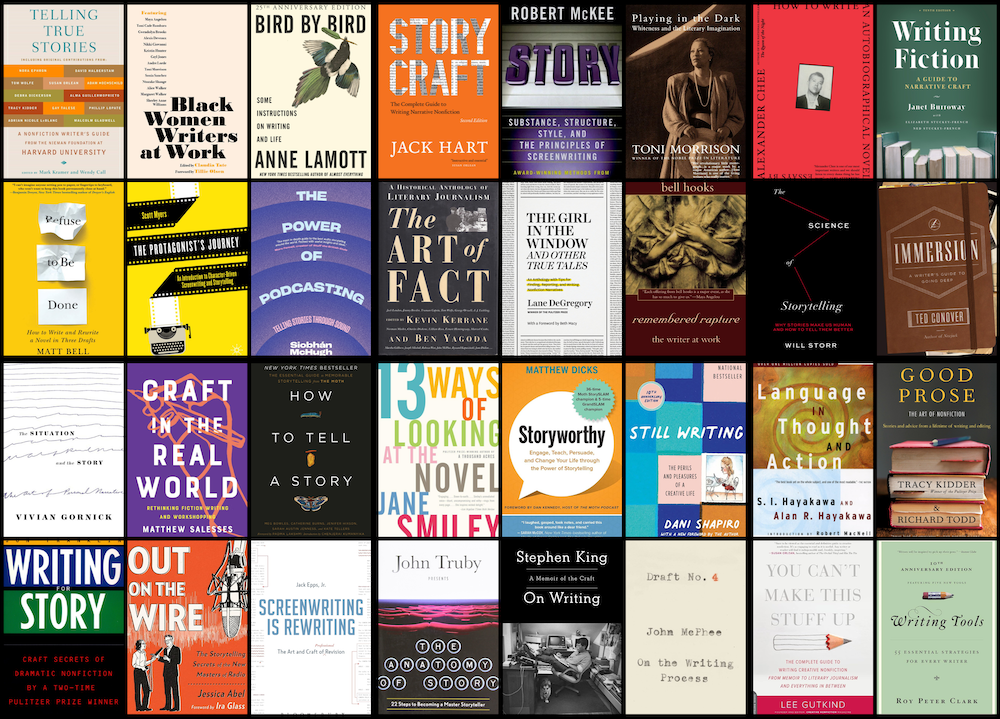
- “Nieman Storyboard’s Best of 2025” (Mark Armstrong)
- “The Nieman Storyboard Guide to Books on Storytelling” (Mallary Tenore Tarpley)
- “A firsthand account from the Texas floods” (Mark Armstrong)
- “Pulitzer winner Mary Schmich's journey from newspapers to podcasts with ‘Division Street Revisited’” (Nieman Storyboard Podcast)
- “We need fact-checkers more than ever. Here's how to work with one” (Kim Cross)
- “Annotation: Megan Greenwell on holding out for the once-in-a-lifetime book idea” (Carly Stern)
- “Behind the Scenes: Bloomberg examines a private detention center and a town 'Addicted to ICE'” (Mark Armstrong)
- “Danyel Smith on developing taste as a writer and building confidence to tell your own story” (Christina A. Tapper, Nieman Storyboard podcast)
- “Erika Hayasaki on trauma-informed reporting and celebrating the ‘reported essay’” (Nieman Storyboard Podcast)
- “How to tell stories about life and death (and everything in between)” (Emilia Wisniewski)
Some stats: In October, Nieman Storyboard’s website garnered its highest traffic in four years, and this year, Storyboard grew its weekly newsletter audience by double-digit percentages. The podcast is nearing 10,000 downloads for its first year, and our Bluesky following is growing and worthy of continued focus.
Storyboard followers can subscribe to the Nieman Storyboard podcast on Apple Podcasts, Spotify, YouTube, and other podcast apps.