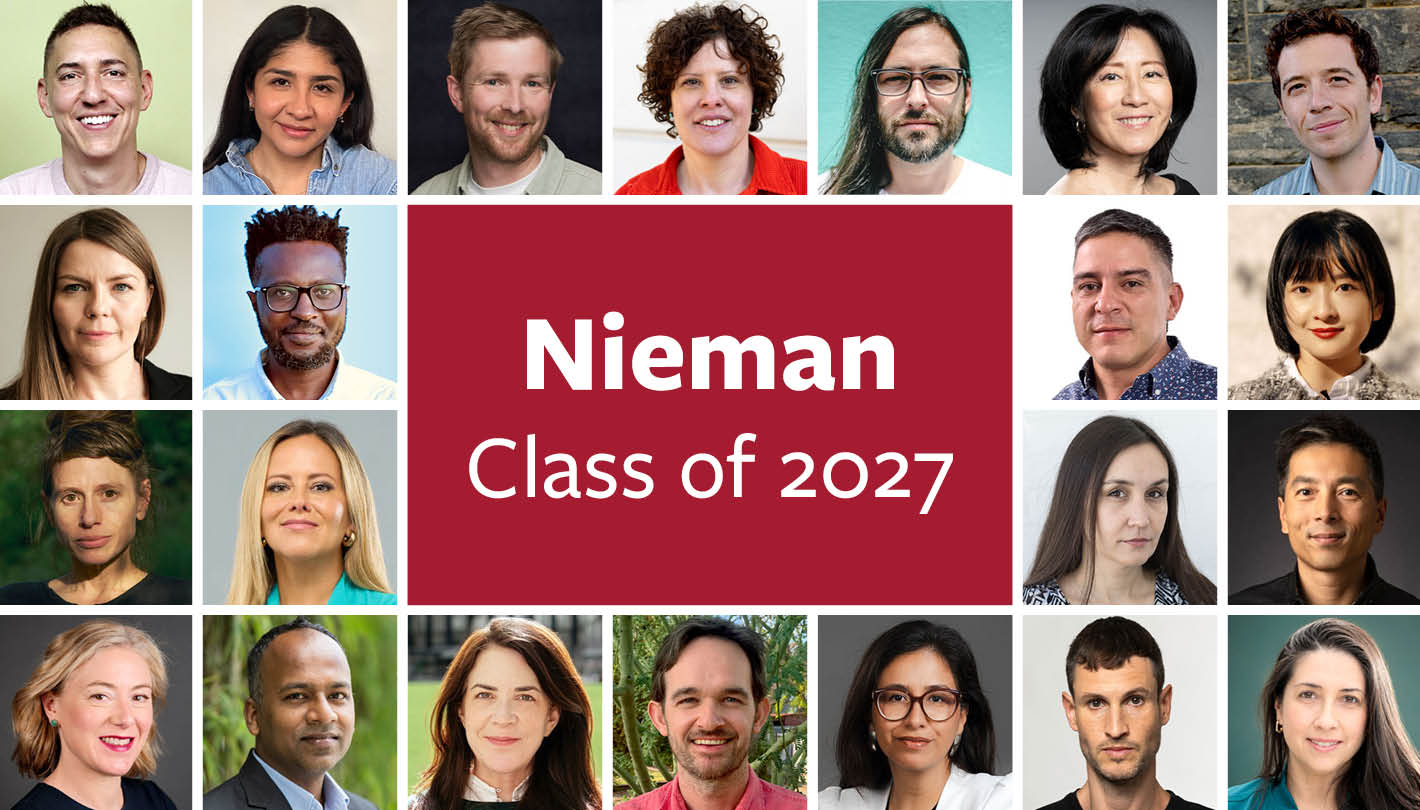
The Nieman Foundation for Journalism has selected 22 talented journalists from around the world as members of the Class of 2027.
The 89th cohort of Nieman Fellows comprises reporters, editors, investigative journalists, visual journalists, an audience engagement specialist, and a television correspondent, who collectively use text, audio, photography, video, and illustration to tell their stories. Based in 12 different countries, they cover topics ranging from the environment, marginalized communities, and the human impact of war to corruption, economic inequality, disinformation, and national security.
The new fellows work for legacy news organizations, at digital outlets, on television, and as independent journalists.
Announcing the class, Nieman Interim Curator Henry Chu said: “These accomplished new fellows have shown through their work why journalism still matters — how it illuminates the forces shaping our lives, uncovers hidden stories, and holds the powerful to account. The year they’ll spend at Harvard will strengthen them as leaders in the field at a time when press freedom has become increasingly precarious worldwide.”
During two semesters of study at Harvard University beginning this fall, the fellows will research topics that will help them better understand how press restrictions and new technologies such as generative AI are changing the nature of reporting; how to better cover underserved communities; how to rebuild trust in journalism; and how to bring fresh perspectives on the impact of climate change.
The Nieman Foundation has selected more than 1,800 journalists from 100 countries for fellowships at Harvard since its founding in 1938. Fellows audit classes across the university, collaborate with scholars and students at Harvard and MIT, and participate in Nieman seminars and workshops.
The 2027 Nieman Fellows and their study plans:
Juan Pablo Barrientos, editor of the investigative unit at the Colombian digital news outlet CasaMacondo, will study access-to-information laws in the Americas, focusing on countries where such laws do not exist or have been rolled back.
Amber Bracken, a Canadian photojournalist, will study the long-term impact of colonization on the identities of both the colonizers and the colonized, including concepts of race, cultural alienation, and relationship to the land.
Graham Lee Brewer, most recently a national writer for The Associated Press based in Oklahoma, will study relations between tribal governments and the U.S., as well as the impact of imperialism on Indigenous storytelling and recordkeeping.
Cara Buckley, a climate solutions reporter for The New York Times, will study whether and how polarization can be overcome and coalitions can be built for effective political action on climate and the environment.
George Butler, a British illustrator who documents the impact of war and humanitarian crises, will explore the lessons journalists can learn from traditional drawn reportage to better serve audiences grappling with complex stories in the era of generative AI.
Hilo Glazer, a writer for Haaretz Magazine in Israel, will examine democratic backsliding in a global context, focusing on its institutional dimension and using that knowledge to develop new approaches for investigative journalism.
Justin Jin, a photographer, writer, and National Geographic Explorer based in Brussels and Shanghai, will study philosophy and geopolitics to bring greater interpretive depth to his visual reporting across differing worldviews.
Benji Jones, a senior correspondent at Vox who covers environmental issues, will study how people relate to and value the natural world, in order to strengthen journalism about the global biodiversity crisis.
Stacy Kranitz, a visual journalist based in Tennessee who focuses on economic inequality in Appalachia, will study the role of photography in shaping public narratives and policy debates about poverty.
Romina Mella, managing editor of the Peruvian investigative outlet IDL-Reporteros, will study the impact of disinformation strategies and violent discourse used by special-interest groups to delegitimize investigative journalism and undermine democracy.
Rowan Moore Gerety, an independent journalist who focuses on the intersection of science, law, and society, will look at the evolving use of animals in medical research, with new advances allowing the study of adaptations and genes across the animal kingdom.
Ellen Nakashima, a national security reporter for The Washington Post, will study the impact of emerging technologies on U.S. defense and intelligence agencies and their ability to meet the challenges posed by multiple adversaries in an evolving global order.
Isabelle Niu, a video journalist for The New York Times, will study how displacement and migration shape communities across borders and how journalists’ own personal backgrounds bear on their reporting.
Jake Offenhartz, a New York-based reporter for The Associated Press who writes about civil unrest and law enforcement, will study the shifting nature of mass movements in the U.S. and the corresponding rise in government repression.
Maurice Oniang’o, a Kenyan investigative reporter who covers systemic abuses and institutional failures across East Africa, will look at how to design sustainable, collaborative models for investigative journalism in the region.
Oksana Parafeniuk, a Ukrainian photojournalist based in Kyiv, will study how exposure to prolonged conflict affects children and how best to visually document their experiences, especially in long-form formats.
Vivian Pasquet, a reporter and editor for Germany’s Süddeutsche Zeitung Magazin, will explore scientific breakthroughs, especially in AI and medicine, that can potentially divide societies, and what can be done to ameliorate it.
Cecilia Reyes, an investigative reporter based in the Midwestern U.S., will study how individuals are affected by repeated interviews after a traumatic event, and the best practices for journalists collecting firsthand accounts.
Sagar, a senior staff writer for The Caravan in India, will examine the impact of the Indian media’s systemic exclusion of perspectives of people from marginalized castes and the measures that can improve coverage of those communities.
Erin Smith, a Boston-based journalist who most recently was a senior engagement editor at Politico, will study survey science, crowdsourcing, and AI-assisted methods to help journalists better measure public opinion on sensitive topics.
Harriet Torry, a Houston-based U.S. economics correspondent for The Wall Street Journal, will study the forces shaping labor-market outcomes, especially for women and with particular attention to the gender pay gap, in an era of profound technological change.
Claudia Uceda, a national television correspondent for TelevisaUnivision who covers the U.S. government, will examine how Spanish-language journalists can survive newsroom cutbacks by leveraging AI and emerging technologies to better serve Latino audiences.
The 2027 Nieman Fellows were selected by Nieman Foundation Interim Curator Henry Chu with assistance from 2020 Nieman Fellow Selymar Colón, managing director of the digital media company Platea PR in Puerto Rico; 2015 Nieman Fellow Elaine Díaz Rodríguez, membership director for the Tiny News Collective; 2024 Nieman Fellow Ilya Marritz, an independent audio journalist; and 2025 Nieman Fellow Line Vaaben, an existential editor and immersive journalist at the Danish daily newspaper Politiken.
The Nieman Foundation for Journalism at Harvard educates leaders in journalism, promotes innovation, and elevates the standards of the profession. In addition to offering Nieman Fellowships, the foundation publishes Nieman Reports, an online magazine covering thought leadership in journalism; Nieman Journalism Lab, a website reporting on the future of news, innovation, and best practices in the digital age; and Nieman Storyboard, a website showcasing exceptional narrative journalism and nonfiction storytelling.