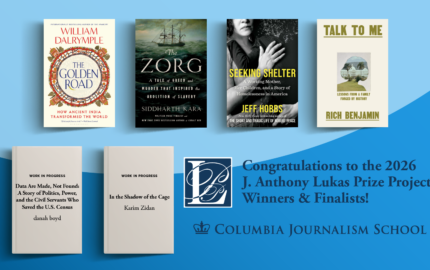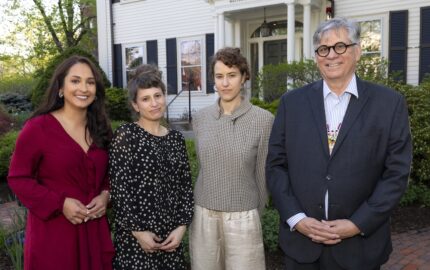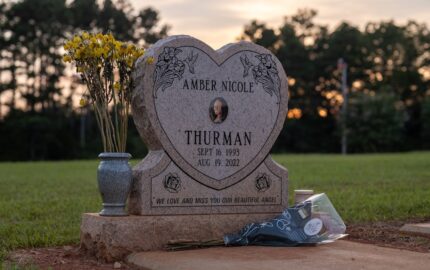
Columbia Journalism School and the Nieman Foundation for Journalism at Harvard University are pleased to announce the 2026 shortlists for the J. Anthony Lukas Work-in-Progress Prizes, the J. Anthony Lukas Book Prize, and the Mark Lynton History Prize. The Lukas Prize Project, established in 1998, honors the best in American nonfiction book writing.
The winners and finalists of the 2026 Lukas Prizes will be announced on Tuesday, March 17. The awards will be presented at a ceremony at Columbia University in May 2026.
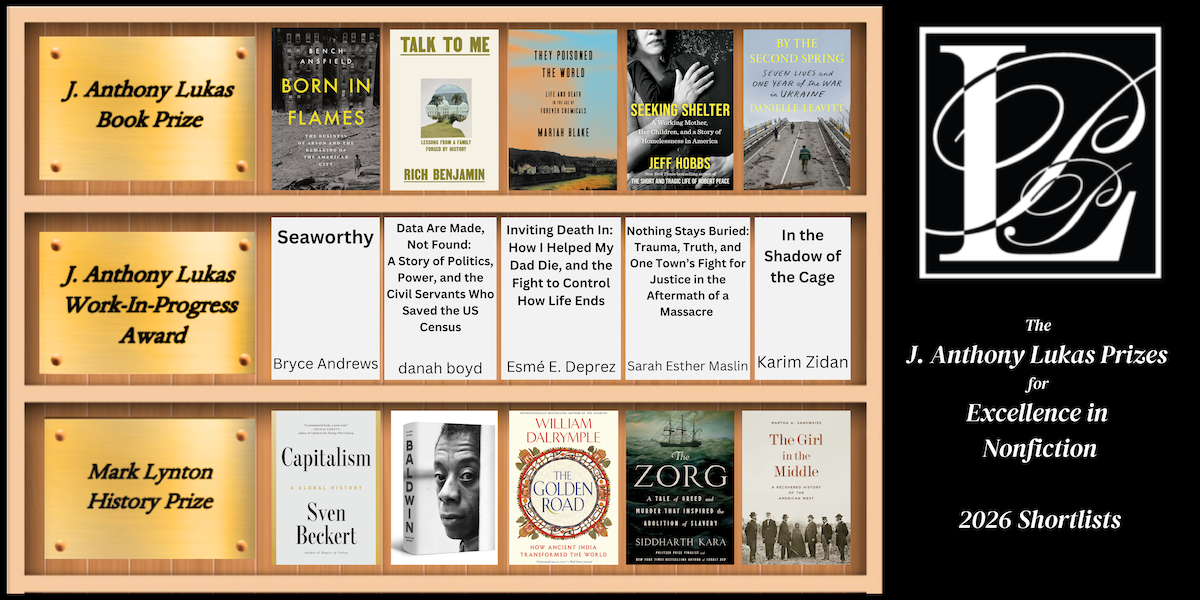
J. Anthony Lukas Work-in-Progress Prizes Shortlist
- Bryce Andrews, Seaworthy (W.W. Norton)
- danah boyd, Data Are Made, Not Found: A Story of Politics, Power, and the Civil Servants Who Saved the U.S. Census (University of Chicago Press)
- Esmé E. Deprez, Inviting Death In: How I Helped My Dad Die, and the Fight to Control How Life Ends (Atria)
- Sarah Esther Maslin, Nothing Stays Buried: Trauma, Truth, and One Town’s Fight for Justice in the Aftermath of a Massacre (Spiegel & Grau)
- Karim Zidan, In the Shadow of the Cage (One Signal)
J. Anthony Lukas Book Prize Shortlist
- Bench Ansfield, Born in Flames: The Business of Arson and the Remaking of the American City (W.W. Norton)
- Rich Benjamin, Talk to Me: Lessons from a Family Forged by History (Pantheon)
- Mariah Blake, They Poisoned the World: Life and Death in the Age of Forever Chemicals (Crown)
- Jeff Hobbs, Seeking Shelter: A Working Mother, Her Children, and a Story of Homelessness in America (Scribner)
- Danielle Leavitt, By the Second Spring: Seven Lives and One Year of the War in Ukraine (Farrar, Straus and Giroux)
Mark Lynton History Prize Shortlist
- Sven Beckert, Capitalism: A Global History (Penguin Press)
- Nicholas Boggs, Baldwin: A Love Story (Farrar, Straus and Giroux)
- William Dalrymple, The Golden Road: How Ancient India Transformed the World (Bloomsbury)
- Siddharth Kara, The Zorg: A Tale of Greed and Murder That Inspired the Abolition of Slavery (St. Martin’s Press)
- Martha A. Sandweiss, The Girl in the Middle: A Recovered History of the American West (Princeton University Press)
About the Prizes
Established in 1998, the Lukas Prize Project honors the best in American nonfiction book writing. Co-administered by Columbia Journalism School and the Nieman Foundation for Journalism at Harvard, and sponsored by the family of the late Mark Lynton, a historian and senior executive at the firm Hunter Douglas in the Netherlands, the Lukas Prize Project presents four awards annually.
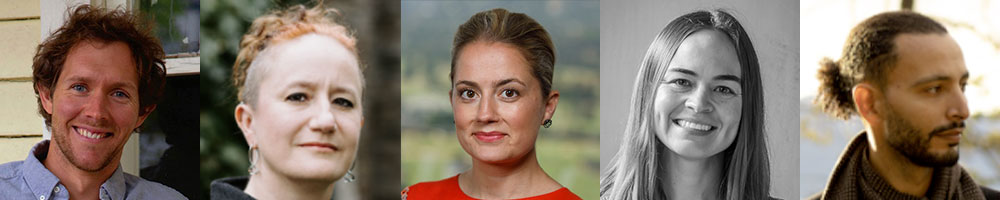
J. Anthony Lukas Work-in-Progress Prizes (two $25,000 prizes)
The J. Anthony Lukas Work-in-Progress Prizes are given annually to aid authors in the completion of significant works of nonfiction on American topics of political or social concern. Judges this year: Krithika Varagur (chair), Walter Harrington, and Erroll McDonald.
Bryce Andrews, Seaworthy (W.W. Norton)
Bryce Andrews is an author, farmer, and conservationist. He was raised in the Pacific Northwest and lives with his family on the Flathead Reservation in Montana. He is fascinated by the complex relationships between humans, wild animals, and the places that sustain them. He has written about wolves, ranchers, cornfield grizzly bears, climate change, intergenerational legacies of violence in the American West, and blacksmithing. Andrews’ work has been honored with regional and national awards.
Seaworthy is about navigating a modern coast by ancient means. Beginning in the Duwamish River Superfund Site and ending in British Columbia’s Desolation Sound, Seaworthy follows a 400-mile northward voyage in a rowboat made of old-growth yellow cedar. As Andrews encounters oil tankers, industrialized shorelines, island farmers, First Nations fishermen, loggers, and yachters, we glimpse a region at an ecological crossroads. Braiding personal narrative, natural history, and interviews, Seaworthy faces difficult questions without seeking simple answers. It is a book about rediscovering the perils and prospects of our home waters. Its central pillars are damage, resilience, effort, and hope.
danah boyd, Data Are Made, Not Found: A Story of Politics, Power, and the Civil Servants Who Saved the U.S. Census (University of Chicago Press)
danah boyd is the Geri Gay Professor of Communication at Cornell University, where she works on topics at the intersection of technology and society. She is also the founder of the research institute Data & Society and the author of It’s Complicated: The Social Lives of Networked Teens.
By many measures, the U.S. decadal census is the government’s largest non-wartime operation. The 2020 census required more than a decade of planning and data processing to count each of 331,449,281 residents once—and only once—and in the right place. In the U.S., census data anchor American democracy and, consequently, political forces configure the making of census data. Data Are Made, Not Found explores what it took for the Census Bureau to make census data in 2020—amidst a global pandemic and natural disasters while navigating political forces that constrained the budget, micromanaged the schedule, and attacked the methods that statisticians used. Despite the challenges in 2020, civil servants managed to successfully produce high-quality data that was used to apportion Congress, redraw Congressional districts, and distribute federal funding. However, each move in what boyd calls “Jenga politics” has made the census infrastructure more precarious. What will it take for bureaucrats to continue pulling off “the impossible”?
Esmé E. Deprez, Inviting Death In: How I Helped My Dad Die, and the Fight to Control How Life Ends (Atria)
Esmé E. Deprez is an investigative journalist based in California and her home state of Maine. She spent 14 years at Bloomberg News and Bloomberg Businessweek as a senior reporter on the investigations team and before that, as a national breaking news and feature correspondent covering state and federal politics and policy. Her reporting has taken her to nearly 40 U.S. states and overseas, and her work has been a finalist for the National Magazine Awards and Livingston Awards; honored by the Nieman Foundation and the National Press Club, among others; and the recipient of a 2025 Silvers Grant. She is a graduate of Columbia Journalism School.
Inviting Death In is a deeply reported, character-driven chronicle of the evolution of medically assisted death, a once-illicit idea now increasingly legal and available to more people in more places around the U.S. and the world. Inspired by Deprez’s 2021 Businessweek story about her terminally ill father’s decision to hasten his end in Maine, it will marry the historical, the clinical, and the personal as it probes the scientific discoveries, political movements, legal precedents, cultural quandaries, and bioethical concepts that have shaped our approaches to death, dying, and desire for control. It will tell the inside story of the still nascent field of U.S. aid-in-dying medicine, and offer a rich and nuanced understanding of what the practice is and is not, who it touches, and what is at stake.
Sarah Esther Maslin, Nothing Stays Buried: Trauma, Truth, and One Town’s Fight for Justice in the Aftermath of a Massacre (Spiegel & Grau)
Sarah Esther Maslin is an award-winning journalist who has worked across Latin America and currently lives in Mexico City. She was previously The Economist’s Brazil bureau chief, and before that was based in San Salvador and Buenos Aires. Her work has appeared in The Washington Post, The New York Times Magazine, The Atlantic, The Nation, and The New Republic, among others.
Nothing Stays Buried chronicles the long aftermath of a massacre in El Mozote, a village in El Salvador where U.S.-trained soldiers killed more than 800 civilians over three days in 1981. The book weaves together the story of a community overwhelmed by trauma but galvanized by a fight for justice, with the story of a country still troubled by cycles of violence, repression, and migration, a generation after a U.S.-financed civil war. Nothing Stays Buried is the culmination of more than a decade of fly-on-the-wall reporting, hundreds of interviews, and extensive research. It will deepen our understanding of the long-term repercussions of atrocities and, crucially, of U.S. intervention. At the same time, it is a human story that asks the question: “What scars does trauma leave on people and communities?”
Karim Zidan, In the Shadow of the Cage (One Signal)
Karim Zidan is an investigative journalist who has reported on the intersection of sports and politics for more than a decade. He is a regular contributor to The Guardian, and his work has been featured in The New York Times and Foreign Policy, among other outlets. His reporting on authoritarian sports strategies has received numerous award nominations and was the basis of an award-winning HBO documentary. He also runs Sports Politika, a media venture dedicated to his beat.
In the Shadow of the Cage tells the story of how political operators have captured mixed martial arts and turned it into a tool to radicalize young people toward a mindset that centers individualism and survival of the fittest while shirking empathy. Zidan began reporting on this phenomenon in Eastern Europe, and continues exploring the underbelly of MMA in the Middle East and the United States, documenting its evolution into the ground zero of a new wave of right-wing, hypermasculine counterculture.
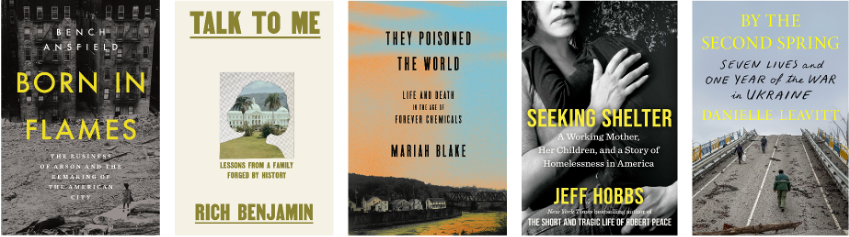
J. Anthony Lukas Book Prize ($10,000)
The J. Anthony Lukas Book Prize recognizes superb examples of book-length nonfiction writing that exemplify the literary grace, commitment to serious research, and original reporting that characterized the distinguished work of the award’s namesake, J. Anthony Lukas. Books must be on a topic of American political or social concern published between January 1 and December 31, 2025. Judges this year: Héctor Tobar (chair), Carol Anderson, Geoff Shandler, and Anna Louie Sussman.
Bench Ansfield, Born in Flames: The Business of Arson and the Remaking of the American City (W.W. Norton)
Bench Ansfield is an assistant professor of history at Temple University. Ansfield holds a Ph.D. in American studies from Yale University and won the Allan Nevins Prize for the best dissertation in American history from the Society of American Historians. They live in Philadelphia, Pennsylvania.
“Ladies and gentlemen, the Bronx is burning!” That legendary and apocryphal phrase, allegedly uttered by announcers during the 1977 World Series as flames rose above Yankee Stadium, seemed to encapsulate an entire era of urban history. Across that decade, a wave of arson coursed through American cities, destroying entire neighborhoods home to poor communities of color. Yet as Ansfield demonstrates in Born in Flames, the most destructive fires were not set by residents, as is commonly assumed, but by landlords looking to collect insurance payouts. Driven by perverse incentives—new government-sponsored insurance combined with tanking property values—landlords hired “torches,” mostly Black and Brown youth, to set fires. Ansfield shows that as the FIRE industries—finance, insurance, and real estate—eclipsed manufacturing in the 1970s, they began profoundly reshaping Black and Brown neighborhoods, seeing them as easy sources of profit. While charting tenant-led resistance movements, Ansfield shows how similarly pernicious dynamics around insurance and race are still at play in our own era, especially in regions most at risk of climate shocks.
Rich Benjamin, Talk to Me: Lessons from a Family Forged by History (Pantheon)
Rich Benjamin is a cultural anthropologist whose writing has appeared in The New Yorker, The New York Review of Books, and The New York Times. He is also a sought-after lecturer and a public-facing scholar often interviewed in international media, including on MSNOW, NPR, CNN, and BBC. His work has received support from the Dorothy and Lewis B. Cullman Center for Scholars and Writers, the Effron Center at Princeton University, MacDowell, Civitella, and the Harvard-Radcliffe Institute for Advanced Study. He is the author of Searching for Whitopia: An Improbable Journey to the Heart of White America.
Talk to Me is an account of the coup that ended Benjamin’s grandfather’s presidency of Haiti, the secrecy that shrouded the wound within his family, and his urgent efforts to know his mother despite the past. It also provides a bold, pugnacious portrait of America—of the human cost of the country’s hostilities abroad, the experience of migrants on these shores, and how the indelible ties of family endure through triumph and loss from generation to generation.
Mariah Blake, They Poisoned the World: Life and Death in the Age of Forever Chemicals (Crown)
Mariah Blake is an investigative journalist whose writing has appeared in The New York Times, The Atlantic, Mother Jones, The New Republic, and other publications. She was a Murrey Marder Nieman Fellow in Watchdog Journalism at Harvard University.
They Poisoned the World is a gripping investigation of the chemical industry’s decades-long campaign to hide the dangers of forever chemicals, told through the story of a small town on the frontlines of an epic public health crisis. In 2014, after losing several friends and relatives to cancer, an unassuming insurance underwriter discovered dangerous levels of forever chemicals in his tap water. This set off a chain of events that led to 100 million Americans learning their drinking water was tainted—and that the U.S. government and the manufacturers of these toxic chemicals had known about their hazards for decades. Blake tells the astonishing story of this cover-up, tracing its roots back to the Manhattan Project and through the postwar years, as industry scientists discovered that these chemicals did not break down and were saturating the blood of virtually every human being. Drawing on years of on-the-ground reporting and tens of thousands of documents, Blake interweaves the secret history of forever chemicals with the moving story of how a lone village took on the chemical giants—and won.
Jeff Hobbs, Seeking Shelter: A Working Mother, Her Children, and a Story of Homelessness in America (Scribner)
Jeff Hobbs is the New York Times bestselling author of The Short and Tragic Life of Robert Peace, which won the Los Angeles Times Book Prize, was a finalist for the Pen/Faulkner Award in Biography, was a finalist for the Carnegie Medal in Nonfiction, and was made into the 2024 film “Rob Peace.” He is also the author of Show Them You’re Good and Children of the State. He lives in Los Angeles with his family.
In 2018, poverty and domestic violence cast Evelyn and her children into the urban wilderness of Los Angeles, where she avoided the family crisis network that offered no clear pathway for her children to remain together and in a decent school. For the next five years, Evelyn worked full-time as a waitress—yet remained unable to afford legitimate housing or qualify for government aid. All the while, she delivered her children to school every day and strove to provide them with loving memories and college aspirations. Eventually, Evelyn encountered Wendi, a recently trained social worker who, decades earlier, survived her own relationship trauma and housing crisis. Evelyn became one of Wendi’s first clients, and the relationship transformed them both. Told from the perspectives of Evelyn, Wendi, and Evelyn’s teenaged son Orlando, Seeking Shelter is a vivid exploration of homelessness, poverty, and education in America—a must-read for anyone interested in understanding not just social inequality and economic disparity in our society, but also the power of a mother’s love and vision for her kids.
Danielle Leavitt, By the Second Spring: Seven Lives and One Year of the War in Ukraine (Farrar, Straus and Giroux)
Danielle Leavitt holds a Ph.D. in history from Harvard University, where she was a fellow at the Ukrainian Research Institute. She grew up in both Ukraine and the United States and now lives in Ann Arbor, Michigan. Leavitt is a fellow at the Weiser Center for Europe and Eurasia at the University of Michigan, where she teaches and writes about Ukraine. By the Second Spring is her first book.
Since Russia’s full-scale invasion of Ukraine in 2022, many Americans have identified deeply with the Ukrainian cause, while others have cast doubt on its relevance to their concerns. Meanwhile, even as scores of Americans rally to the Ukrainian cause and adopt Volodymyr Zelenskyy as a hero, the lives of Ukrainians remain opaque and mostly anonymous. In By the Second Spring, Danielle Leavitt goes beyond familiar portraits of wartime heroism and victimhood to reveal the human experience of the conflict. An American who grew up in Ukraine, Leavitt draws on her deep familiarity with the country and a unique trove of online diaries to track a diverse group of Ukrainians through the first year of Russia’s full-scale invasion. Writing with closeness and compassion, Leavitt has given us an interior history of Europe’s largest land war in 75 years.
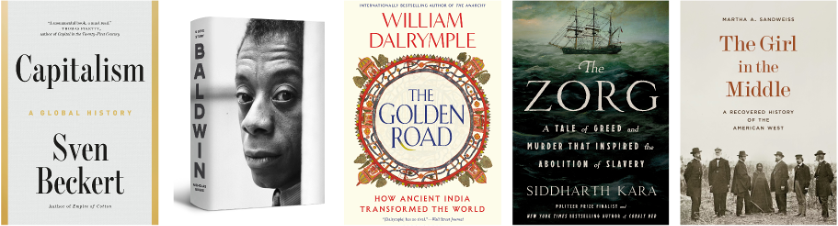
Mark Lynton History Prize ($10,000):
The Mark Lynton History Prize is awarded to the book-length work of narrative history, on any subject, that best combines intellectual distinction with felicity of expression. Books must have been published between January 1 and December 31, 2025. Judges: Scott Reynolds Nelson (chair), Geraldo Cadava, Ann Fabian, and Manisha Sinha.
Sven Beckert, Capitalism: A Global History (Penguin Press)
Sven Beckert is the Laird Bell Professor of history at Harvard University. Holding a Ph.D. from Columbia University, he has written widely on the economic, social, and political history of capitalism. His book Empire of Cotton won the Bancroft Prize, was a finalist for the Pulitzer Prize, and was named one of the 10 best books of the year by The New York Times. He has been the recipient of numerous awards and fellowships, including from Harvard Business School, the Dorothy and Lewis B. Cullman Center for Scholars and Writers, and the John Simon Guggenheim Memorial Foundation. He is an elected member of the American Academy of Arts and Sciences and lives in Cambridge, Massachusetts.
In Capitalism, Beckert places the story of capitalism within the largest conceivable framework, tracing its history across the world during the past millennium. Emerging from trading communities across Asia, Africa, and Europe, capitalism’s radical recasting of economic life began gradually, but then burst onto the world stage, as a powerful alliance between European states and merchants propelled their economic logic across the oceans. One epicenter of modern capitalism’s big bang was the slave labor camps of the Caribbean. This system, with its hierarchies that haunt us still, incited the radical transformations of the Industrial Revolution. Fueled by vast productivity increases along with coal and oil, capitalism pulled down old ways of life to crown itself the defining force of the modern world. Capitalism shows that, though cloaked in a sense of timelessness and universality, capitalism is, in reality, a recent human invention. Beckert charts a way to look through and beyond capitalism to imagine a different world.
Nicholas Boggs, Baldwin: A Love Story (Farrar, Straus and Giroux)
Nicholas Boggs co-edited a new edition of Baldwin’s collaboration with French artist Yoran Cazac, Little Man, Little Man: A Story of Childhood, in 2018. He is the recipient of a 2023 Whiting Creative Nonfiction Grant and fellowships from the Leon Levy Center for Biography, the Scholars-in-Residence program at the Schomburg Center for Research in Black Culture, the Gilder Lehrman Center and Beinecke Library at Yale, and the National Endowment for the Humanities, as well as residencies at Yaddo and MacDowell. Most recently, he was the 2024-2025 John Hope Franklin Fellow at the National Humanities Center. Born and raised in Washington, DC, he received his B.A. from Yale and his Ph.D. from Columbia, both in English, as well as an M.F.A. in Creative Writing from American University. He resides in New York City.
Drawing on new archival material, original research, and interviews, Baldwin: A Love Story is the first major biography of James Baldwin in three decades, revealing how profoundly his personal relationships shaped his life and work. Boggs shows how Baldwin drew on all the complex forces within his closest relationships, and alchemized them into novels, essays, and plays that speak truth to power and had an indelible impact on the civil rights movement and on Black and Queer literary history.
William Dalrymple, The Golden Road: How Ancient India Transformed the World (Bloomsbury)
William Dalrymple is the prize-winning author of numerous books, including White Mughals, The Last Mughal, and Return of a King. A frequent broadcaster, he has written and presented three television series, one of which won the Grierson Award for Best Documentary Series at BAFTA. He writes regularly for The New York Review of Books, The New Yorker, and The Guardian. William lives with his wife and three children on a goat farm outside of Delhi.
For a millennium and a half, India was a confident exporter of its culture, creating around it a vast empire of ideas. Indian art, religions, technology, astronomy, music, dance, literature, mathematics, and mythology blazed a trail across the world that stretched from the Red Sea to the Pacific. Dalrymple draws from a lifetime of scholarship to highlight India’s oft forgotten position as the heart of ancient Eurasia. From the largest Hindu temple in the world at Angkor Wat to Buddhism in Japan, from the trade that helped fund the Roman Empire to the creation of the numerals we use today, India transformed the culture and technology of the ancient world—and our world today as we know it. Yet somehow this vast Indosphere has never had a name, until now: The Golden Road. Dalrymple transforms our understanding of how the ancient world was built and what debt we in modern times owe to India’s intellectual, spiritual, and commercial contributions.
Siddharth Kara, The Zorg: A Tale of Greed and Murder That Inspired the Abolition of Slavery (St. Martin’s Press)
Siddharth Kara is an author, researcher, and activist focused on modern slavery. He has written several books and reports on slavery and child labor, including The New York Times bestseller and Pulitzer Prize finalist, Cobalt Red. He divides his time between Los Angeles and London.
In October 1780, a slave ship set sail from the Netherlands, bound for Africa’s Windward and Gold Coasts. When a series of unpredictable weather events and navigational errors led to the Zorg sailing off course and running low on supplies, the ship’s captain threw more than a hundred slaves overboard. The ship’s owners then claimed their loss on insurance, a first for slaves who had not been killed due to insurrection or died of natural causes. The insurers refused to pay due to the higher than usual mortality rate of the slaves on board, leading to a trial that was initially found in their favor. Thanks to the outrage of one man present in court that day, a retrial was held. For the first time, human rights and morality entered the discourse on slavery in a courtroom case that boiled down to a simple question: Were the Africans on board people or cargo? The Zorg reveals how the case catapulted the anti-slavery movement from a minor evangelical cause to one of the most consequential moral campaigns in history and sparked the abolitionist movement in both England and the United States.
Martha A. Sandweiss, The Girl in the Middle: A Recovered History of the American West (Princeton University Press)
Martha A. Sandweiss is professor emerita of history at Princeton University, where she is founding director of the Princeton & Slavery Project. She is the award-winning author of many books, including Passing Strange: A Gilded Age Tale of Love and Deception across the Color Line and Print the Legend: Photography and the American West.
In The Girl in the Middle, Martha A. Sandweiss paints a riveting portrait of the turbulent age of Reconstruction and westward expansion. She follows celebrated Civil War photographer Alexander Gardner from his birthplace in Scotland to the American frontier, as his dreams of a utopian future across the Atlantic fall to pieces. She recounts the lives of William S. Harney, a slave-owning Union general who earned the Lakota name “Woman Killer,” and Samuel F. Tappan, an abolitionist who led the investigation into the Sand Creek massacre. Most significantly, Sandweiss identifies the girl in the middle of Gardner’s photograph taken at Fort Laramie as Sophie Mousseau, whose life swerved in unexpected directions as American settlers pushed into Indian Country and the federal government confined Native peoples to reservations.
About Columbia Journalism School
For more than a century, Columbia Journalism School has been preparing journalists in programs that stress academic rigor, ethics, journalistic inquiry and professional practice. Founded with a gift from Joseph Pulitzer, the school opened its doors in 1912 and offers a Master of Science, Master of Arts, a joint Master of Science degree in Computer Science and Journalism and Doctor of Philosophy in Communications. It houses the Columbia Journalism Review, the Brown Institute for Media Innovation and the Tow Center for Digital Journalism. The school also administers many of the leading journalism awards, including the Alfred I. duPont-Columbia University Awards, the Maria Moors Cabot Prizes, the John Chancellor Award, the John B. Oakes Award, the J. Anthony Lukas Prize Project, the Paul Tobenkin Memorial Award and the Meyer “Mike” Berger Award.
www.journalism.columbia.edu | @columbiajourn
About the Nieman Foundation for Journalism at Harvard
The Nieman Foundation for Journalism at Harvard educates leaders in journalism, promotes innovation, and elevates the standards of the profession. More than 1,700 journalists from 100 countries have been awarded Nieman Fellowships since 1938. The foundation also publishes Nieman Reports, an online magazine covering thought leadership in journalism; Nieman Journalism Lab, a website reporting on the future of news, innovation, and best practices in the digital media age; and Nieman Storyboard, a website showcasing exceptional narrative journalism and nonfiction storytelling.
nieman.harvard.edu | @niemanfoundation.bsky.social